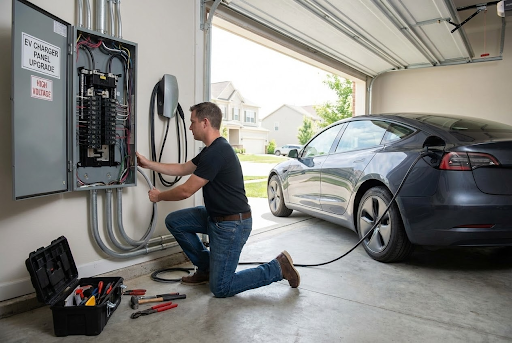
Understanding EV Panel Installation in Orange County is essential for homeowners preparing their property for electric vehicle charging. EVs place continuous, high-demand electrical loads on a home — far more than traditional appliances. A professional installation is not just about plugging in a charger. It requires electrical engineering, load calculations, safety controls, permitting, and often a full panel upgrade to prevent overloads, fire risks, and failed inspections.
Cutting corners here doesn’t just cause inconvenience — it creates liability, insurance problems, and genuine fire hazards.
Initial Assessment and Planning
A proper home EV charger setup begins with a full electrical evaluation. Licensed electricians do not guess — they calculate.
They assess:
- Panel capacity and condition to determine if the existing system can support an EV charger safely
- Total electrical load of the home, including HVAC, water heaters, appliances, and solar
- Available amperage after all existing circuits are accounted for
- Charging location to minimize wire runs while keeping the charger convenient
- Vehicle charging requirements, including recommended amperage and connector type
- Future demand, such as adding a second EV or installing solar and battery storage
This step prevents a common mistake: installing a charger that exceeds the home’s electrical capacity.
Electrical Panel Evaluation
The electrical requirements of modern electric cars are substantial. Level 2 chargers typically draw 30–50 amps continuously, which is far more demanding than appliances that cycle on and off.
The electrician determines:
- Whether the existing panel has sufficient capacity
- If there are open breaker slots
- Whether the panel brand or age presents safety risks
- If the service entrance (utility feed) can handle the increased load
Many older homes still operate on 100-amp or 125-amp service. That is barely enough for modern living — let alone EV charging. Most professional EV installations in Orange County are upgraded to 200-amp service, which provides the capacity needed for EVs, air conditioning, appliances, and future upgrades.
Installation Components
A residential charging station installation is a system, not just a device.
It includes:
Panel upgrade or new EV circuit
Either a full panel replacement or the installation of a dedicated 240-volt EV circuit with properly sized breakers.
Wiring
Heavy-gauge copper wiring is run from the panel to the charger. Routing is planned for efficiency, code compliance, and appearance.
Circuit protection
EV chargers require:
- Proper breaker sizing
- Ground-fault and arc-fault protection
- Load calculations that prevent overheating
Charger mounting
The EV charging station is mounted on a wall, pedestal, or garage surface at a safe height and distance from vehicles.
System testing
Electricians verify voltage, amperage, grounding, and communication with the charger before activation.
Code Compliance and Permitting
Professional EV Panel Installation Orange County includes full regulatory compliance.
This means:
- City permits
- National Electrical Code (NEC) compliance
- Grounding and bonding
- Load calculations
- GFCI and safety device installation
- Final inspection
Skipping permits is not a shortcut — it is a legal and insurance nightmare. Unpermitted EV installations can void homeowners’ insurance and fail during property sales or refinancing.
Choosing the Right EV Charger
EV charger selection is not cosmetic — it affects safety, speed, and future flexibility.
Electricians help evaluate:
Charging speed
Vehicles vary in how much power they can accept. Installing an oversized charger on an undersized panel is pointless.
Hardwired vs plug-in
Hardwired chargers:
- Are safer
- Allow higher amperage
- Meet more code requirements
Plug-in units are cheaper but often limited.
Smart features
Many chargers support:
- Scheduled charging
- Load management
- Wi-Fi monitoring
- Utility rate optimization
These features require stable electrical infrastructure.
Cable length and weather rating
Outdoor installations require weather-sealed equipment and longer cables.
Optimizing the Charging Location
Location affects cost, safety, and convenience.
Professionals consider:
- Distance from the electrical panel
- Parking position
- Vehicle charge port location
- Exposure to rain and sun
- Security
- Future garage or parking layout changes
A poor location choice can double installation cost due to long wire runs and conduit requirements.
Timeline and Process
Typical EV panel installation follows this sequence:
- Week 1: Electrical assessment, load calculation, permit submission
- Week 2–3: Permit approval and scheduling
- Week 3–4: Panel upgrade, wiring, and charger installation
- Week 4: Final inspection and activation
Simple installations without panel upgrades may finish faster. Full service upgrades require utility coordination and inspections.
Post-Installation Support
Quality contractors don’t disappear after the charger turns on.
They provide:
- Operating instructions
- Load-management setup
- Warranty coverage
- Troubleshooting support
- Future upgrade services
This matters when adding a second EV or integrating solar and battery storage later.
Conclusion
Professional EV Panel Installation in Orange County is the backbone of safe, reliable electric vehicle ownership. EV chargers are not simple appliances they are high-demand electrical systems that require proper engineering, modern panels, and code-compliant installation.
A correctly installed EV panel upgrade protects your home, your vehicle, your insurance, and your investment while giving you fast, safe charging for years to come. Cutting corners here costs far more than doing it right the first time.