The intricate balance of the mammalian circulatory system relies on a sophisticated network of signaling molecules that regulate blood flow and vessel integrity. Among these, arachidonic acid derivatives known as eicosanoids play a pivotal role. Thromboxane A2 (TXA2) is a potent lipid mediator primarily synthesized by activated platelets. Despite its short half life, which spans approximately 30 seconds under physiological conditions, its impact on cardiovascular health and inflammatory responses is profound. Understanding the precise concentration of this molecule is essential for researchers investigating thrombosis, hypertension, and tissue ischemia.
The Biosynthetic Pathway of Thromboxane A2
The generation of TXA2 begins with the release of arachidonic acid from cellular membranes via the enzyme phospholipase A2. This free fatty acid is subsequently converted into prostaglandin H2 (PGH2) by the action of cyclooxygenase enzymes (COX-1 or COX-2). In platelets, the enzyme thromboxane synthase further metabolizes PGH2 to produce TXA2.
Once synthesized, TXA2 exerts its effects by binding to the thromboxane prostanoid (TP) receptor, a G protein coupled receptor located on the surface of platelets and vascular smooth muscle cells. This binding triggers a cascade of intracellular events, including the mobilization of calcium ions, which leads to two primary outcomes: platelet aggregation and potent vasoconstriction. Because TXA2 is rapidly hydrolyzed into its inactive metabolite, Thromboxane B2 (TXB2), direct measurement of the active form requires highly sensitive and specific analytical tools.
Clinical Relevance and Research Applications
Abnormal levels of TXA2 are linked to several pathological states. In the context of cardiovascular disease, excessive production of this mediator can lead to the formation of intravascular thrombi, potentially resulting in myocardial infarction or stroke. Conversely, its role in the inflammatory response involves the modulation of leukocyte adhesion and the regulation of vascular permeability.
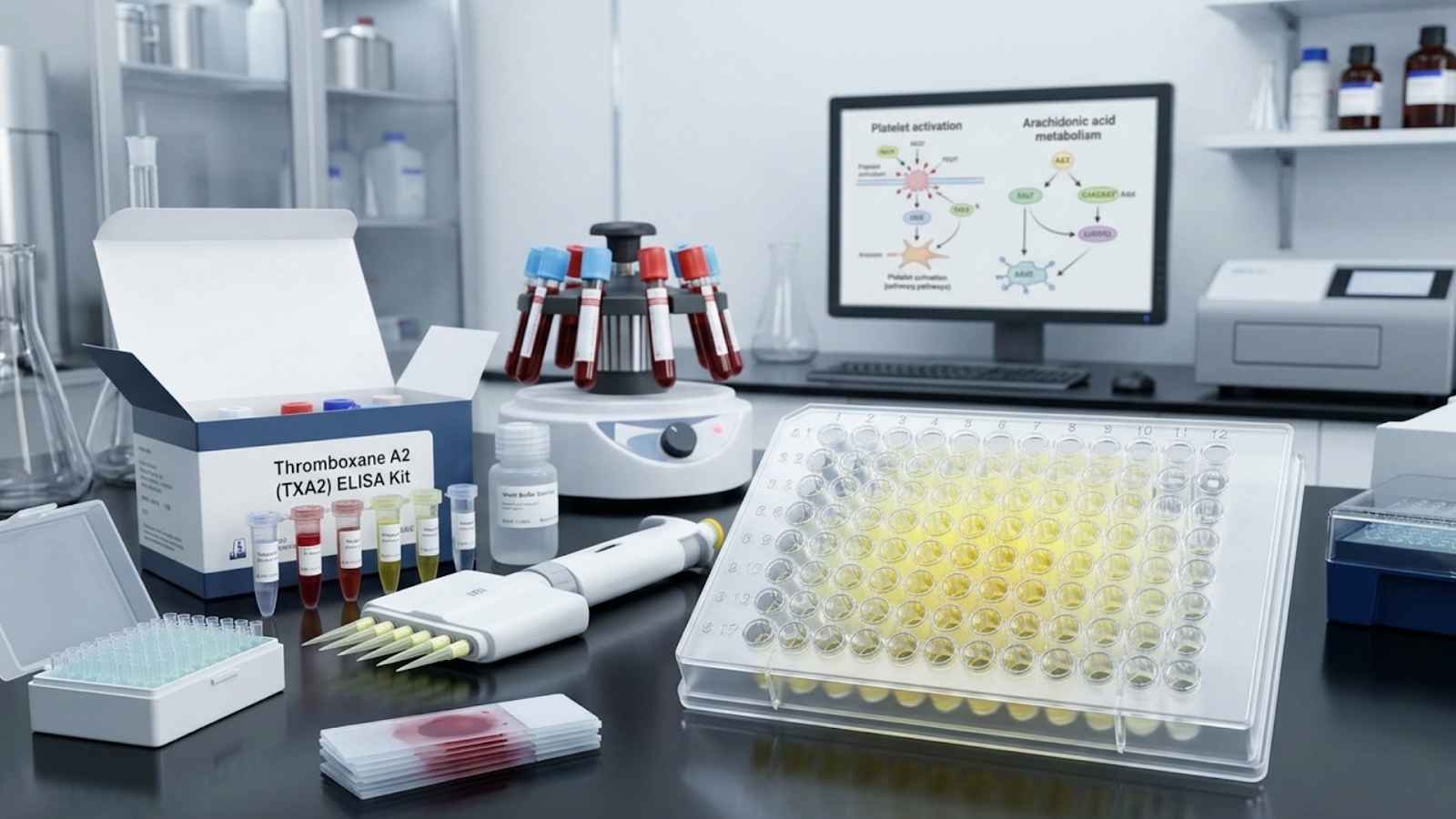
In pharmacological research, the inhibition of TXA2 production is a key strategy for antiplatelet therapy. Low dose aspirin, for example, irreversibly inhibits the COX-1 enzyme, thereby reducing the synthesis of TXA2 and lowering the risk of thrombotic events. Researchers studying these mechanisms require a reliable Thromboxane A2 (TXA2) ELISA Kit to quantify changes in mediator levels following drug administration or genetic modification in animal models.
Enzyme Linked Immunosorbent Assay (ELISA) Principles
The ELISA remains the preferred method for quantifying small molecules like TXA2 due to its high sensitivity and throughput capabilities. Competitive ELISA formats are frequently employed for lipid mediators. In this setup, the target analyte in the sample competes with a labeled version of the analyte for binding sites on a limited number of specific antibodies.
The intensity of the signal produced is inversely proportional to the concentration of the analyte in the sample. This means that a sample with high levels of TXA2 will result in less labeled tracer binding to the plate, leading to a weaker colorimetric or fluorescent signal. This method allows for the detection of picogram quantities of the mediator, which is necessary given the transient nature of eicosanoids in biological fluids such as serum, plasma, or cell culture supernatants.
Factors Influencing Assay Accuracy
To ensure the validity of molecular data, several technical factors must be addressed during the execution of an ELISA. The choice of sample preparation is critical. Because platelets can release TXA2 during the blood collection process, researchers must use specific anticoagulants and inhibitors to prevent “ex vivo” synthesis, which would otherwise skew the results.
Furthermore, cross reactivity is a significant concern in eicosanoid research. Since many prostaglandins share structural similarities with TXA2, the antibodies used in the kit must demonstrate high specificity. MyBioSource provides specialized reagents designed to minimize such interference, ensuring that the data reflected represents the actual concentration of the intended target rather than related lipid species.
The Importance of Standardized Kits
While some laboratories attempt to develop in house assays, the use of commercially validated kits offers distinct advantages in terms of reproducibility and time efficiency. A standardized Thromboxane A2 (TXA2) ELISA Kit includes pre coated plates, stabilized standards, and optimized buffers that have undergone rigorous testing. This standardization is vital for multi center studies where data from different laboratories must be compared or combined.
Modern research increasingly focuses on the synergistic effects of various mediators. For instance, the ratio between prostacyclin (a vasodilator) and thromboxane (a vasoconstrictor) is often more informative than the absolute concentration of either molecule alone. High quality ELISA systems enable the precise measurements required to calculate these critical ratios, providing a clearer picture of the vascular environment.
Conclusion
The study of Thromboxane A2 continues to yield insights into the fundamental mechanisms of vascular biology and disease progression. As a potent regulator of platelet function and vascular tone, its accurate measurement is indispensable for both basic science and drug development. Through the application of advanced immunoassays, researchers can continue to explore the nuances of eicosanoid signaling, ultimately contributing to the development of more effective interventions for cardiovascular and inflammatory disorders. Maintaining strict adherence to validated protocols and utilizing high quality detection systems ensures that the resulting data serves as a solid foundation for future medical advancements.