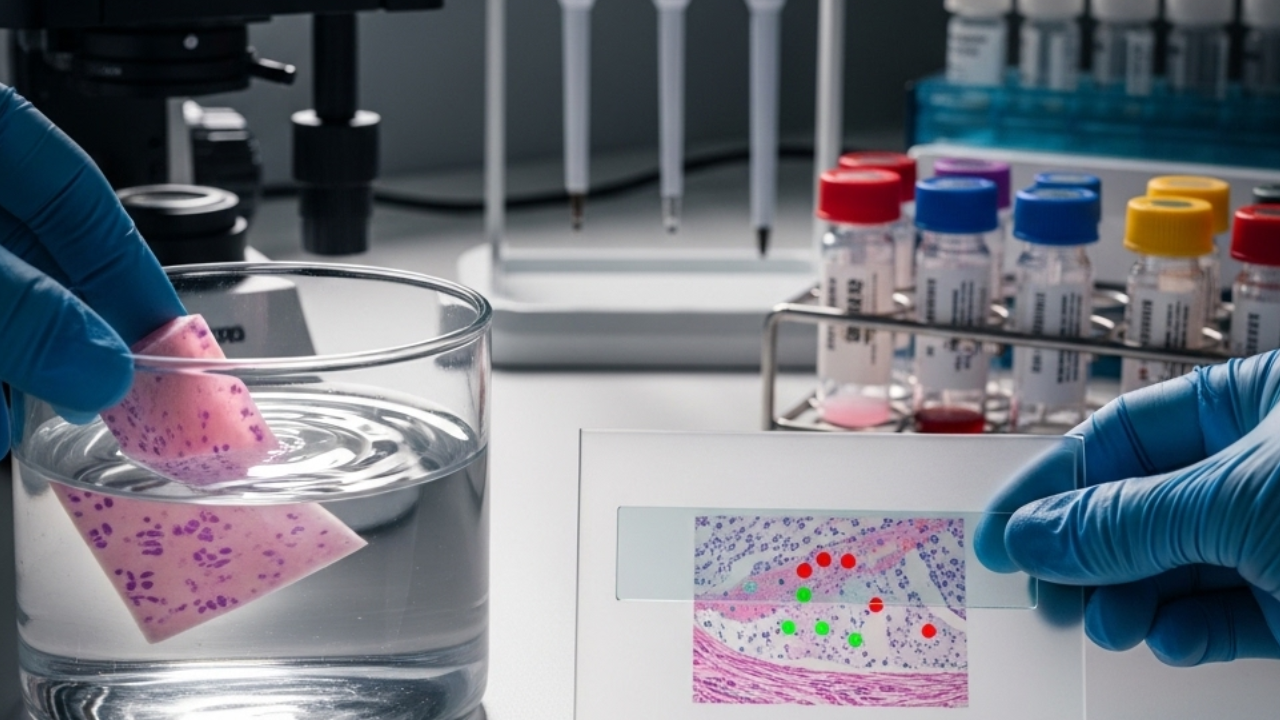
You’ve spent countless months:
- Designing your study
- Carefully selecting patient samples
- Planning which biomarkers to evaluate
However, you then reach the final critical step—tissue fixation. It is so easy to overlook, yet issues with fixation can make the immunohistochemistry (IHC) results:
- Inconsistent
- Unreliable
- Misleading data
Delayed fixation, over-fixation, or incorrect fixation can degrade antigens, mask key proteins, or lead to uneven staining.
Suddenly, a marker you expected to detect clearly disappears altogether. You know the frustration: only to question whether your results reflect biology or just technical errors.
This is where the right antibodies, such as AAABio’s highly validated monoclonal antibodies, when paired with proper fixation, can help:
- Preserve antigen integrity
- Improve reproducibility
- Ensure your data truly answers the research questions
Let’s learn more about how fixation affects IHC results.
Why Tissue Fixation Matters In IHC?
Tissue fixation is essential because it preserves the appearance of cells and tissues, preventing them from breaking down.
Without it, the proteins you want to study get damaged, making your results unreliable.
Fixatives work by:
- Keeping the cells and proteins in place.
- Stopping the enzymes and microbes from breaking down tissue.
- Keeping antigens intact.
However, be cautious: too little fixation can cause tissue damage, while excessive fixation can obscure the proteins. This makes it harder for antibodies to detect them.
Common Tissue Fixatives and Their Impact
| Fixative | Mechanism | Advantages | Limitations | Best Use Cases |
| Formalin (10% NBF) | Cross-linking proteins | It is widely used as it helps preserve morphology well. | May mask epitopes and requires antigen retrieval. | Routine diagnostics |
| Paraformaldehyde | Cross-linking proteins | Excellent preservation for fluorescence imaging. | Slower penetration; retrieval often needed. | Immunofluorescence & IF-IHC |
| Alcohol-based | Precipitation | Preserves antigenicity better | Can cause tissue shrinkage | Phopho-protein detection |
| Acetone & Methanol | Protein precipitation | Fast-fixation; good for frozen sections | Poor long-term morphology preservation | Quick IF/ IHC assay |
NOTE: The right fixative is important for ensuring maximum antibody binding efficiency. This is where choosing antibodies like monoclonal antibodies that are optimized for IHC comes in. Various sources, like AAA Biotech, provide a wide range of monoclonal antibodies that can be sensitive to fixation conditions.
How Fixation Duration Affects IHC Results
The length of time the tissue is in fixative can make a big difference in your IHC results.
- Under-Fixation: The tissue can start breaking down. Cells lose their shape, and staining may be uneven or weak.
- Over-Fixation: Proteins can get locked too tightly, which hides the parts antibodies need to attach to. This can make signals weak or invisible.
Tip: For most tissue samples that will be embedded in paraffin, 24 hours in 10% neutral buffered formalin works well.
Antigen Retrieval
Formalin fixation is great for preserving tissue, but it can hide the parts of proteins that antibodies need to recognize. This can make the staining weak. That is where antigen retrieval comes in, as it unmasks these hidden sites so antibodies can bind properly.
There are two main ways to do this:
Heat-Induced Epitope Retrieval (HIER)
The tissue is heated in special buffers like citrate or EDTA. The heat helps break the chemical bonds formed during fixation, which makes the epitopes visible again.
Enzymatic Epitope Retrieval (EEIR)
Special enzymes, such as proteinase K, are used to gently digest the cross-links in the tissue. This method is particularly useful for delicate proteins that might be damaged by heat.
Bottom Line
Two things that help get reliable immunohistochemistry (IHC) results:
- Use of the right antibodies
- Ensure your tissue is fixed properly
Pair well-validated antibodies with proper fixation and antigen retrieval. Finally, you can preserve the proteins you care about, get consistent staining, and trust that your data reflects the biology you are studying.