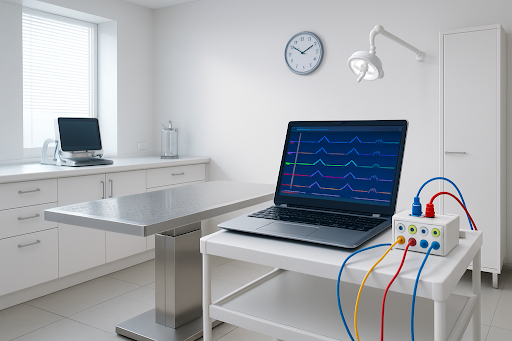
When a dog or cat has unexplained weakness, muscle wasting, or abnormal reflexes, standard imaging may not always reveal the root cause. Electrodiagnostic testing is a powerful set of diagnostic tools that evaluates the electrical function of nerves and muscles, helping veterinary neurologists pinpoint disorders that MRI and CT cannot always detect. These tests are non-destructive, highly informative, and essential for diagnosing a range of neuromuscular diseases.
What Is Electrodiagnostic Testing in Veterinary Medicine?
Electrodiagnostics is the branch of veterinary neurology concerned with measuring and interpreting the electrical activity of the nervous system and muscles. It includes several distinct tests, each designed to evaluate different aspects of nerve and muscle function. Together, they help the clinician determine whether a problem lies in the spinal cord, peripheral nerves, neuromuscular junctions, or muscles themselves.
These tests are especially important in cases of lower motor neuron disease, polyneuropathy, myopathy, and unexplained muscle weakness or atrophy.
Types of Electrodiagnostic Tests
Electromyography (EMG)
Electromyography records the electrical activity within individual muscles using fine needle electrodes inserted into the muscle tissue. In a healthy muscle at rest, there should be very little electrical activity. Abnormal spontaneous activity — such as fibrillation potentials or positive sharp waves — indicates denervation or muscle disease. EMG helps identify which muscles and nerves are affected and provides clues about the duration and severity of the problem.
Nerve Conduction Studies (NCS)
Nerve conduction studies measure how quickly and efficiently electrical signals travel along peripheral nerves. A small electrical stimulus is applied to a nerve at one point, and the resulting response is recorded at another point. Reduced conduction velocity or amplitude suggests nerve damage or demyelination. This nerve stimulation test is particularly useful for diagnosing peripheral neuropathies.
Repetitive Nerve Stimulation (RNS)
RNS is used to evaluate the neuromuscular junction — the interface between motor nerves and muscle fibers. It is particularly helpful for diagnosing myasthenia gravis, a condition in which antibodies interfere with acetylcholine receptors, causing muscle weakness. A decremental response on RNS supports this diagnosis.
F-Wave and H-Reflex Studies
These specialized nerve conduction measurements evaluate the function of motor nerves from the spinal cord to the periphery and back. They are particularly useful for detecting abnormalities in the proximal nerve segments that are difficult to assess with standard NCS.
What Conditions Are Diagnosed with Electrodiagnostic Testing?
Veterinary electrodiagnostics are used to investigate: peripheral polyneuropathy, inherited motor neuron diseases, inflammatory muscle diseases (polymyositis), metabolic myopathies, myasthenia gravis, botulism, nerve root compression, and post-traumatic nerve injuries. In many cases, electrodiagnostic findings guide biopsy site selection and help determine whether medical or surgical treatment is appropriate.
What Does the Testing Process Involve?
Electrodiagnostic testing requires general anesthesia to ensure the patient remains completely still and to allow for accurate recordings. The procedure typically takes one to two hours and is performed by a board-certified veterinary neurologist. Following the procedure, pets recover quickly and are usually discharged the same day.
Results are interpreted in conjunction with the neurological examination, imaging findings, and laboratory data to form a complete clinical picture. In some cases, electrodiagnostic findings will lead to recommendations for muscle or nerve biopsy for definitive diagnosis.
How Is Electrodiagnostic Testing Different from MRI?
MRI provides structural information about the brain, spinal cord, and surrounding tissues. Electrodiagnostics provides functional information about how nerves and muscles are actually working. The two modalities are complementary — one shows structure, the other shows function — and together they form the basis of a complete neurological evaluation.
Conclusion
Electrodiagnostic testing is an invaluable tool in veterinary neurology, offering insights into neuromuscular function that imaging alone cannot provide. From the nerve stimulation test that assesses conduction velocity to EMG recordings that detect muscle denervation, these tools allow veterinary neurologists to diagnose complex conditions with precision. If your pet has unexplained weakness, muscle loss, or abnormal reflexes, a veterinary electrodiagnostic evaluation may be the key to understanding — and treating — the problem.
For more info visit :- thecreativemines.com